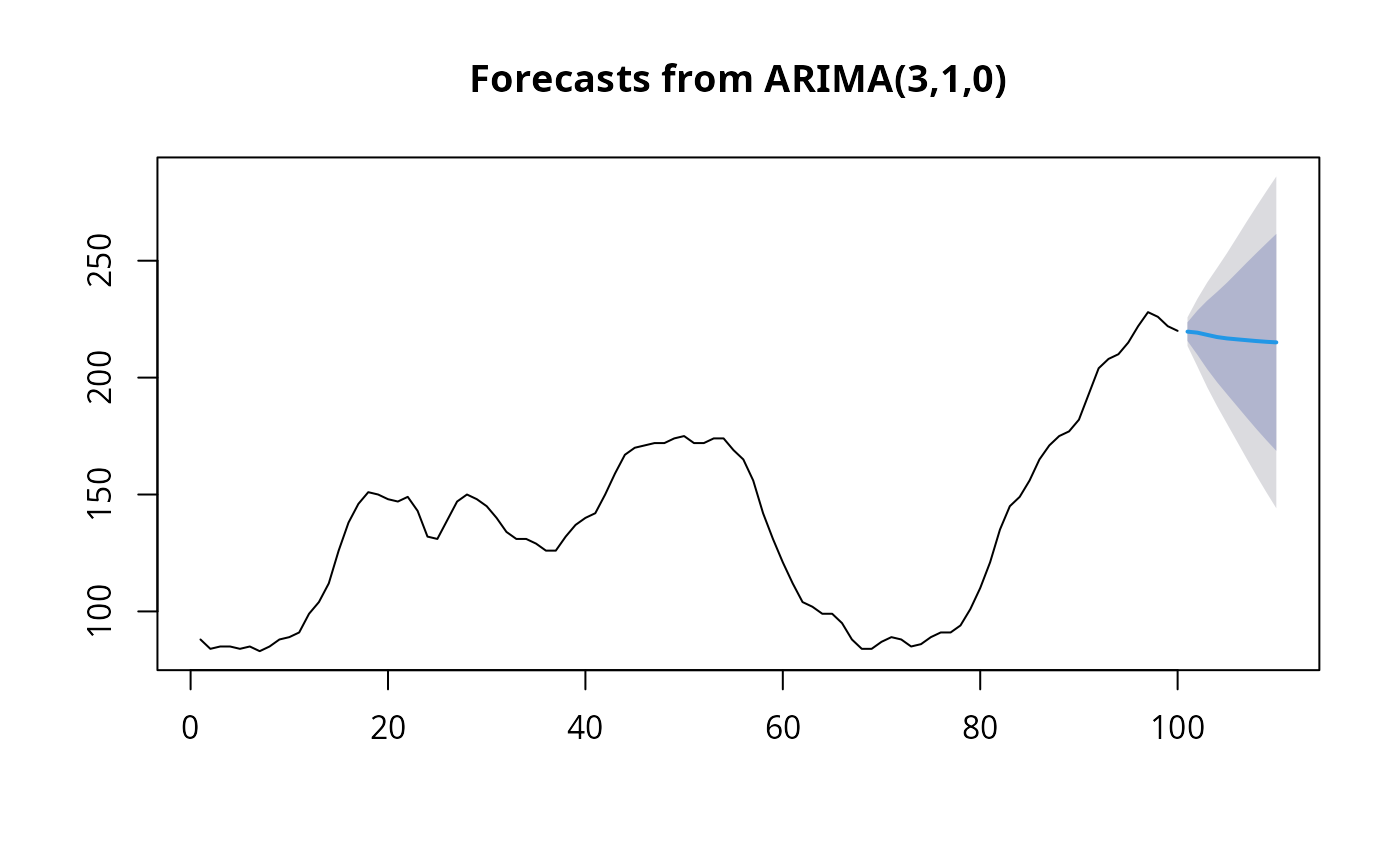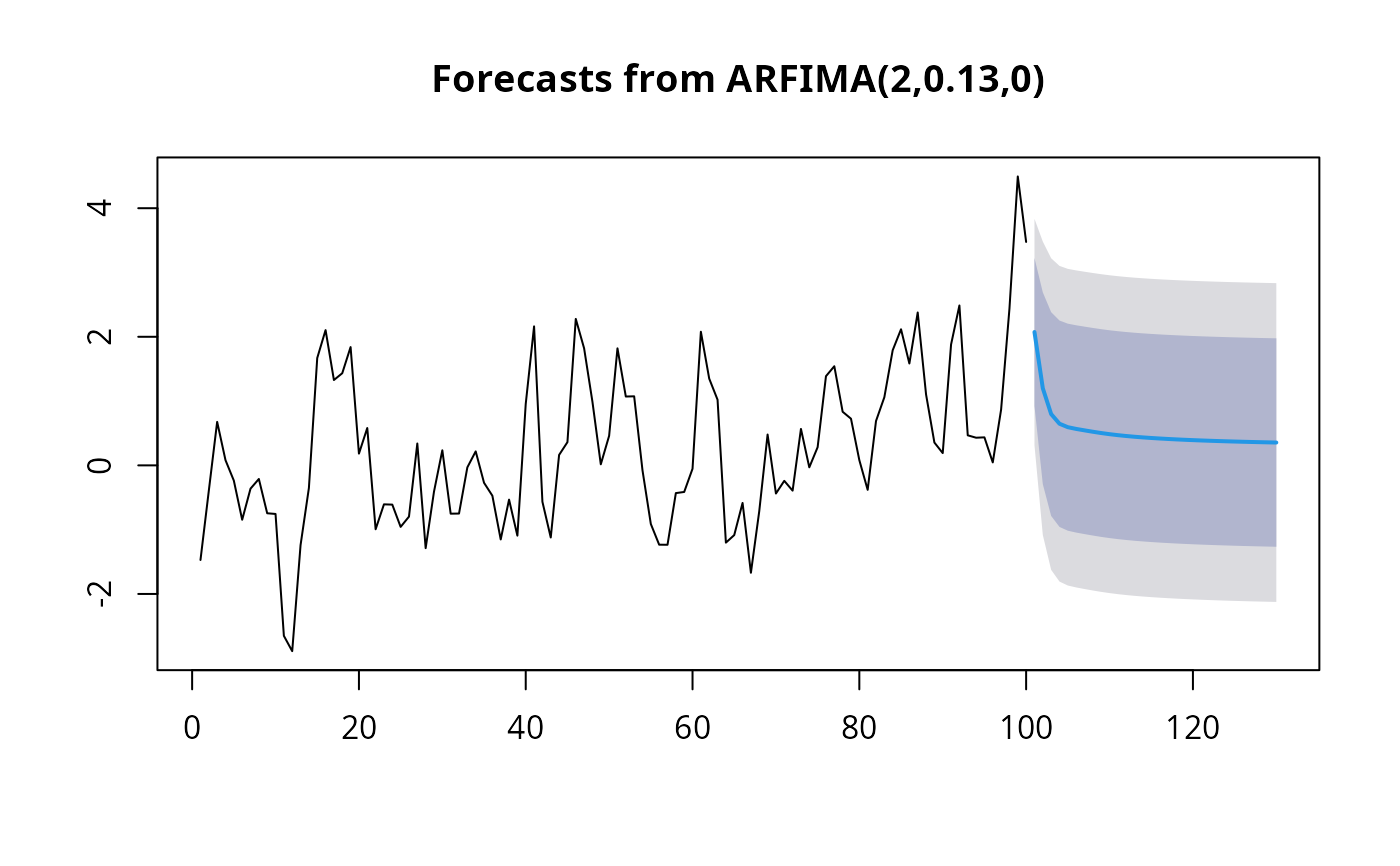
Returns forecasts and other information for univariate ARIMA models.
Usage
# S3 method for class 'fracdiff'
forecast(
  object,
  h = 10,
  level = c(80, 95),
  fan = FALSE,
  lambda = object$lambda,
  biasadj = NULL,
  ...
)

# S3 method for class 'Arima'
forecast(
  object,
  h = ifelse(object$arma[5] > 1, 2 * object$arma[5], 10),
  level = c(80, 95),
  fan = FALSE,
  xreg = NULL,
  lambda = object$lambda,
  bootstrap = FALSE,
  npaths = 5000,
  biasadj = NULL,
  ...
)

# S3 method for class 'ar'
forecast(
  object,
  h = 10,
  level = c(80, 95),
  fan = FALSE,
  lambda = NULL,
  bootstrap = FALSE,
  npaths = 5000,
  biasadj = FALSE,
  ...
)
Arguments
- object
An object of class "
Arima", "ar" or "fracdiff". Usually the result of a call toarima,auto.arima,ar,arfimaorfracdiff.- h
Number of periods for forecasting. If
xregis used,his ignored and the number of forecast periods is set to the number of rows ofxreg.- level
Confidence level for prediction intervals.
- fan
If
TRUE, level is set toseq(51,99,by=3). This is suitable for fan plots.- lambda
Box-Cox transformation parameter. If
lambda="auto", then a transformation is automatically selected usingBoxCox.lambda. The transformation is ignored if NULL. Otherwise, data transformed before model is estimated.- biasadj
Use adjusted back-transformed mean for Box-Cox transformations. If transformed data is used to produce forecasts and fitted values, a regular back transformation will result in median forecasts. If biasadj is TRUE, an adjustment will be made to produce mean forecasts and fitted values.
- ...
Other arguments.
- xreg
Future values of an regression variables (for class
Arimaobjects only). A numerical vector or matrix of external regressors; it should not be a data frame.- bootstrap
If
TRUE, then prediction intervals computed using simulation with resampled errors.- npaths
Number of sample paths used in computing simulated prediction intervals when
bootstrap=TRUE.
Value
An object of class "forecast".
The function summary is used to obtain and print a summary of the
results, while the function plot produces a plot of the forecasts and
prediction intervals.
The generic accessor functions fitted.values and residuals
extract useful features of the value returned by forecast.Arima.
An object of class "forecast" is a list containing at least the
following elements:
- model
A list containing information about the fitted model
- method
The name of the forecasting method as a character string
- mean
Point forecasts as a time series
- lower
Lower limits for prediction intervals
- upper
Upper limits for prediction intervals
- level
The confidence values associated with the prediction intervals
- x
The original time series (either
objectitself or the time series used to create the model stored asobject).- residuals
Residuals from the fitted model. That is x minus fitted values.
- fitted
Fitted values (one-step forecasts)
Details
For Arima or ar objects, the function calls
predict.Arima or predict.ar and
constructs an object of class "forecast" from the results. For
fracdiff objects, the calculations are all done within
forecast.fracdiff using the equations given by Peiris and
Perera (1988).
References
Peiris, M. & Perera, B. (1988), On prediction with fractionally differenced ARIMA models, Journal of Time Series Analysis, 9(3), 215-220.
See also
predict.Arima,
predict.ar, auto.arima,
Arima, arima, ar,
arfima.