Performs Parametric Bootstrap for Sequentially Testing the Number of Components in Various Mixture Models
boot.comp.RdPerforms a parametric bootstrap by producing B bootstrap realizations of the likelihood ratio statistic for testing the null hypothesis of a k-component fit versus the alternative hypothesis of a (k+1)-component fit to various mixture models. This is performed for up to a specified number of maximum components, k. A p-value is calculated for each test and once the p-value is above a specified significance level, the testing terminates. An optional histogram showing the distribution of the likelihood ratio statistic along with the observed statistic can also be produced.
Usage
boot.comp(y, x = NULL, N = NULL, max.comp = 2, B = 100,
          sig = 0.05, arbmean = TRUE, arbvar = TRUE,
          mix.type = c("logisregmix", "multmix", "mvnormalmix",
          "normalmix", "poisregmix", "regmix", "regmix.mixed",
          "repnormmix"), hist = TRUE, ...)
Arguments
- y
The raw data for
multmix,mvnormalmix,normalmix, andrepnormmixand the response values forlogisregmix,poisregmix, andregmix. See the documentation concerning their respective EM algorithms for specific structure of the raw data.- x
The predictor values required only for the regression mixtures
logisregmix,poisregmix, andregmix. A column of 1s for the intercept term must not be included! See the documentation concerning their respective EM algorithms for specific structure of the predictor values.- N
An n-vector of number of trials for the logistic regression type
logisregmix. If NULL, thenNis an n-vector of 1s for binary logistic regression.- max.comp
The maximum number of components to test for. The default is 2. This function will perform a test of k-components versus (k+1)-components sequentially until we fail to reject the null hypothesis. This decision rule is governed by the calculated p-value and
sig.- B
The number of bootstrap realizations of the likelihood ratio statistic to produce. The default is 100, but ideally, values of 1000 or more would be more acceptable.
- sig
The significance level for which to compare the p-value against when performing the test of k-components versus (k+1)-components.
- arbmean
If FALSE, then a scale mixture analysis can be performed for
mvnormalmix,normalmix,regmix, orrepnormmix. The default is TRUE.- arbvar
If FALSE, then a location mixture analysis can be performed for
mvnormalmix,normalmix,regmix, orrepnormmix. The default is TRUE.- mix.type
The type of mixture analysis you wish to perform. The data inputted for
yandxdepend on which type of mixture is selected.logisregmixcorresponds to a mixture of logistic regressions.multmixcorresponds to a mixture of multinomials with data determined by the cut-point method.mvnormalmixcorresponds to a mixture of multivariate normals.normalmixcorresponds to a mixture of univariate normals.poisregmixcorresponds to a mixture of Poisson regressions.regmixcorresponds to a mixture of regressions with normal components.regmix.mixedcorresponds to a mixture of regressions with random or mixed effects.repnormmixcorresponds to a mixture of normals with repeated measurements.- hist
An argument to provide a matrix plot of histograms for the boostrapped likelihood ratio statistic.
- ...
Additional arguments passed to the various EM algorithms for the mixture of interest.
Value
boot.comp returns a list with items:
- p.values
The p-values for each test of k-components versus (k+1)-components.
- log.lik
The B bootstrap realizations of the likelihood ratio statistic.
- obs.log.lik
The observed likelihood ratio statistic for each test which is used in determining the p-values.
Examples
## Bootstrapping to test the number of components on the RTdata.
data(RTdata)
set.seed(100)
x <- as.matrix(RTdata[, 1:3])
y <- makemultdata(x, cuts = quantile(x, (1:9)/10))$y
a <- boot.comp(y = y, max.comp = 1, B = 5, mix.type = "multmix",
epsilon = 1e-3)
#> number of iterations= 28
#> number of iterations= 61
#> number of iterations= 63
#> number of iterations= 62
#> number of iterations= 233
#> number of iterations= 38
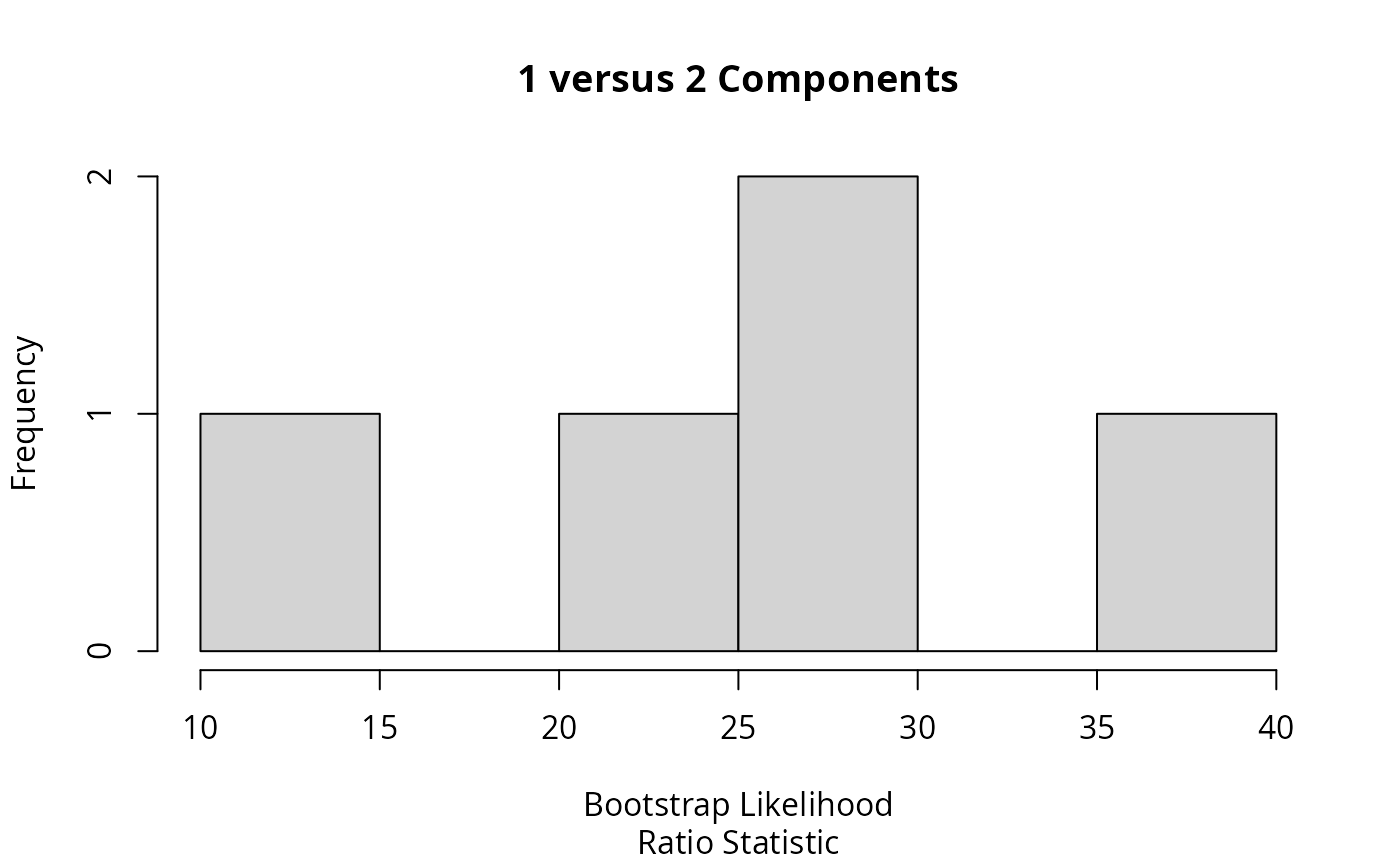 #> Decision: Select 2 Component(s)
a$p.values
#> [1] 0
#> Decision: Select 2 Component(s)
a$p.values
#> [1] 0