Create a DHARMa object from hand-coded simulations or Bayesian posterior predictive simulations.
Source:R/DHARMa.R
createDHARMa.RdCreate a DHARMa object from hand-coded simulations or Bayesian posterior predictive simulations.
Usage
createDHARMa(simulatedResponse, observedResponse,
  fittedPredictedResponse = NULL, integerResponse = FALSE, seed = 123,
  method = c("PIT", "traditional"), rotation = NULL)
Arguments
- simulatedResponse
matrix of observations simulated from the fitted model - row index for observations and column index for simulations.
- observedResponse
true observations.
- fittedPredictedResponse
optional fitted predicted response. For Bayesian posterior predictive simulations, using the median posterior prediction as fittedPredictedResponse is recommended. If not provided, the mean simulatedResponse will be used.
- integerResponse
if T, noise will be added at to the residuals to maintain a uniform expectation for integer responses (such as Poisson or Binomial). Unlike in simulateResiduals, the nature of the data is not automatically detected, so this MUST be set by the user appropriately.
- seed
the random seed to be used within DHARMa. The default setting, recommended for most users, is to keep the random seed on a fixed value 123. This means that you will always get the same randomization and thus the same result when running the same code. NULL = no new seed is set, but previous random state will be restored after simulation. FALSE = no seed is set, and random state will not be restored. The latter two options are only recommended for simulation experiments. See vignette for details.
- method
the quantile randomization method used. The two options implemented at the moment are probability integral transform (PIT-) residuals (current default), and the "traditional" randomization procedure, that was used in DHARMa until version 0.3.0. For details, see getQuantile.
- rotation
optional rotation of the residual space to remove residual autocorrelation. See details in simulateResiduals, section residual auto-correlation for an extended explanation, and getQuantile for syntax.
Details
The use of this function is to convert simulated residuals (e.g. from a point estimate, or Bayesian p-values) to a DHARMa object, to make use of the plotting / test functions in DHARMa.
Examples
## READING IN HAND-CODED SIMULATIONS
testData = createData(sampleSize = 50, randomEffectVariance = 0)
fittedModel <- glm(observedResponse ~ Environment1, data = testData, family = "poisson")
# in DHARMA, using the simulate.glm function of glm
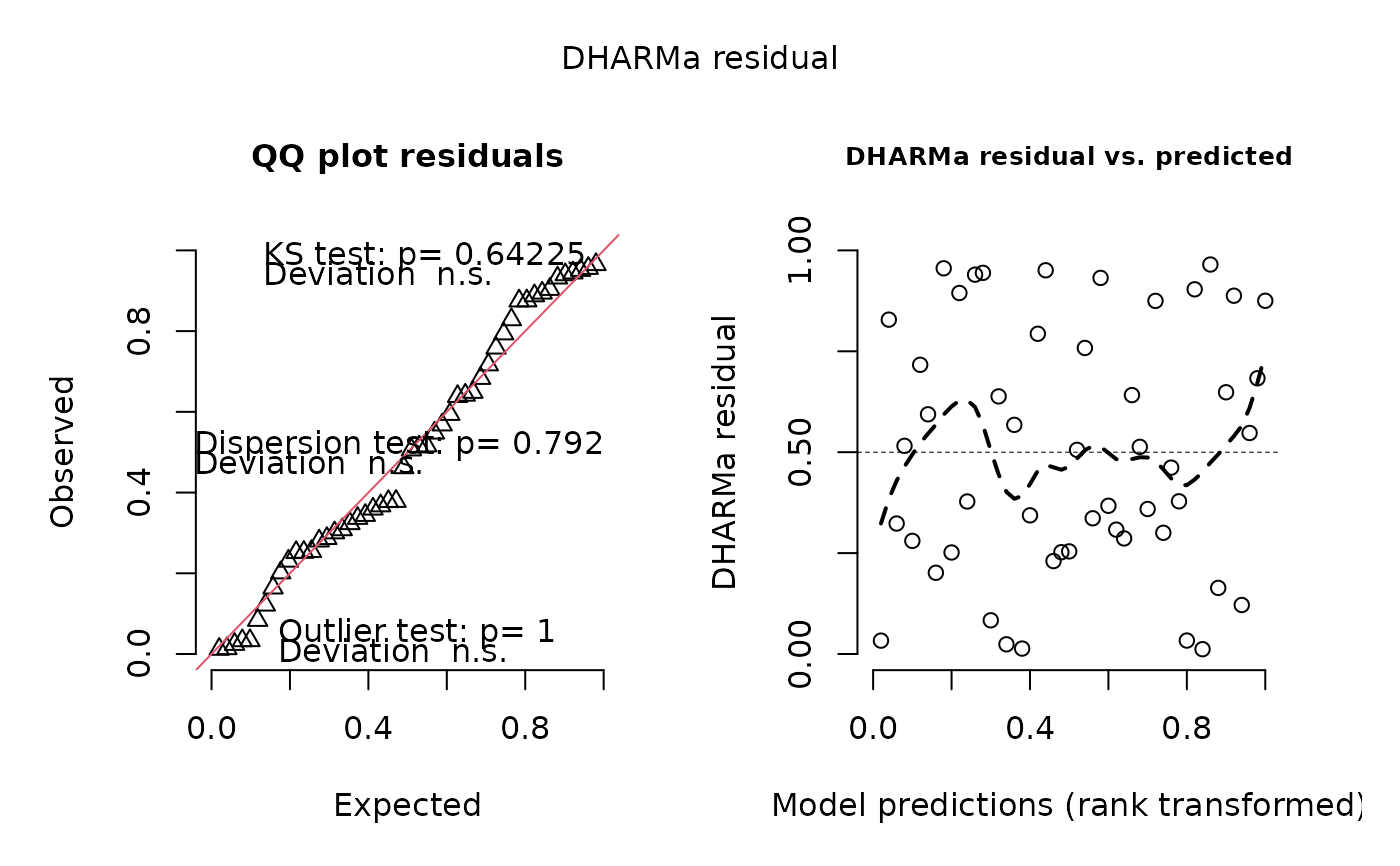
sims = simulateResiduals(fittedModel)
plot(sims, quantreg = FALSE)
 # Doing the same with a handcoded simulate function.
# of course this code will only work with a 1-par glm model
simulateMyfit <- function(n=10, fittedModel){
int = coef(fittedModel)[1]
slo = coef(fittedModel)[2]
pred = exp(int + slo * testData$Environment1)
predSim = replicate(n, rpois(length(pred), pred))
return(predSim)
}
sims = simulateMyfit(250, fittedModel)
dharmaRes <- createDHARMa(simulatedResponse = sims,
observedResponse = testData$observedResponse,
fittedPredictedResponse = predict(fittedModel, type = "response"),
integer = TRUE)
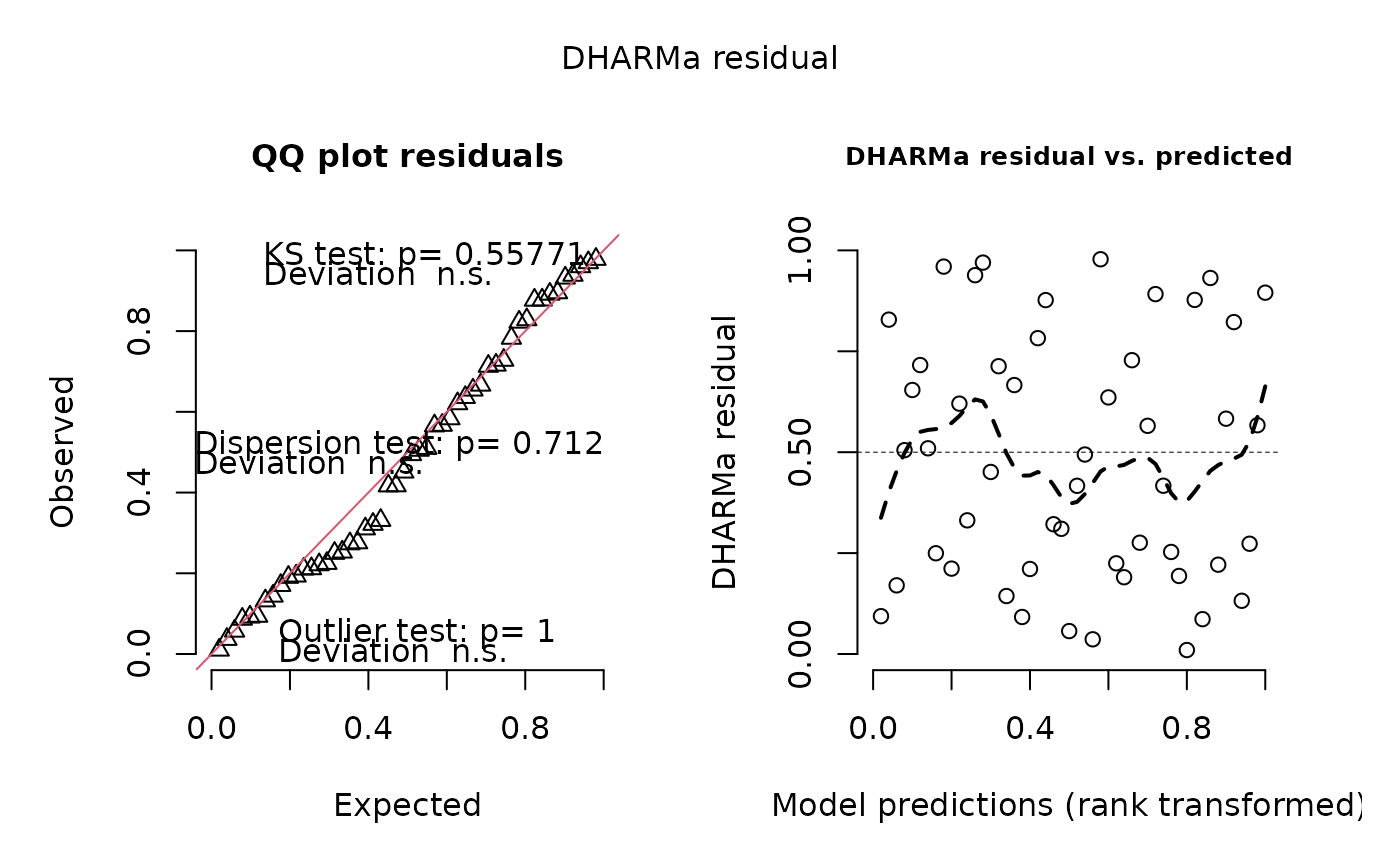
plot(dharmaRes, quantreg = FALSE)
# Doing the same with a handcoded simulate function.
# of course this code will only work with a 1-par glm model
simulateMyfit <- function(n=10, fittedModel){
int = coef(fittedModel)[1]
slo = coef(fittedModel)[2]
pred = exp(int + slo * testData$Environment1)
predSim = replicate(n, rpois(length(pred), pred))
return(predSim)
}
sims = simulateMyfit(250, fittedModel)
dharmaRes <- createDHARMa(simulatedResponse = sims,
observedResponse = testData$observedResponse,
fittedPredictedResponse = predict(fittedModel, type = "response"),
integer = TRUE)
plot(dharmaRes, quantreg = FALSE)